..for now.
I'm sitting in the Dublin airport (local time 12:40am), waiting for my flight to JFK. I have about 10 hours to go, so I'll soon be sleeping - most likely on top of my luggage.
Good night, and I hope you all stay tuned for whatever my next adventure abroad is!
21 May 2009

11 May 2009
Průhonice park
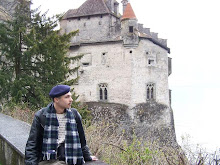
While I was teaching English, I often had to travel just outside Prague to some businesses in Čestlice. On the way, I'd always see this neo-gothic tower sticking up over the town. I later found out that this was part of the château gardens in Průhonice, which is an UNESCO-protected area. Here are some pictures of the park.


08 May 2009
Křivoklát Castle

Hrad Křivoklát


Some shots of the 'interior'. Photography wasn't allowed in any of the rooms however. This irked me, especially since there was a chapel with a beautiful gothic altarpiece, and another room with some 15th/16th century paintings and sculpture. And a library to die for - at one point it was the 3rd largest collection in Bohemia.

These forests used to be a favored hunting area for the local aristocracy.


I'm embarrassed to say that I didn't write down who this person is. I can only remember that it was some prince or another. One of the Fürstenbergs maybe?


A local cat, and quite possibly the largest slug in the world. Largest I've ever seen, at any rate.
07 May 2009
In which I took the drinking cure
 I'm not normally one to drink water (which still baffles my friends), but Goethe and Beethoven couldn't have been wrong about this. They, along with countless others, have visited to Karlovy Vary (aka Karlsbad) to partake in the balneological pleasures of this small spa town. Karl Marx, too, it seems was a repeat customer (1874, '75, and '76).
So the story goes, the hot springs were first discovered in the mid-1300s by none other than Charles IV himself, King of Bohemia and Holy Roman Emperor, while on a hunting trip: one of his hounds fell into one of the hot springs. Here is a 19th century ivory carving depicting the scene, from the collections of the local museum.
Due to the intense geological activity, a ton of hot mineral-rich water (some exceeding 65°C or 149°F) surfaces. Although bathing is quite popular, and there are innumerable spa resorts there, the "drinking cure" is more commonly used to enhance health and well-being. There are many fountains, particularly in the collonades, to take the water from, typically using porcelain spa cups.


Views of the Mill Spring Collonade. Josef Zítek was the architect of this collonade, and also of the National Theater in Prague.
Over the years, Karlovy Vary has become renowned more than just its water. Pewter (since the end of the 17th century), porcelain (end of the 18th) and glass (19th century) have all been important products of the area. Moser glassworks has allegedly made products for "the court of the King of England, the Shah of Persia, the Queen of Holland, and the court in Vienna" (museum guide).
Standing over the city is the Freundschaftshöhe ('Hill of Friendship') surmounted by the Diana lookout tower. One can walk up through the woods or, pressed for time, take the 5 minute funicular ride up. There, you can look back on the city nestled in the gently rolling hills:


The golden domes belong the Church of Saints Peter and Paul, one of the world's largest Russian Orthodox churches, which was as beautiful inside as outside (but I couldn't take pictures inside).


Bonus floral images, taken in some of the city gardens:


03 May 2009
Strahovský klášter
 The Strahov Monastery, situated just southwest of Prague Castle, was founded in 1143. The Premonstratensian order has used it nearly constantly since then (even yesterday I saw a monk in his white robes walking around), with only two major interruptions: between 1420 and the end of the 16th century, following the Hussite rebellion; and between the 1950s and 1989, thanks to the Communist regime.
You can walk around the cloister and some of the adjacent rooms, and admire the extant Romanesque walls and a few columns. A lot of renovation was done in the 17th century, however, so the original vaulting is gone. There is a "secret" stairway (roped off, unfortunately): it's fitted into one of the walls between two of the Romanesque halls.
Upstairs is the art gallery (Strahovská obrazárna) that has holdings from the 15th-18th centuries. I believe that many of the works on display were commissioned or acquired by Rudolf II (read this article from the MMA for more info), however my absolute favorite piece there is a sculpture dated ca. 1500:
Pictured above is God the Father at the coronation of the Virgin (Bůh Otec z výjevu Korunování Panny Marie). Mary isn't present, and unfortunately neither are God's hands. Still, it's a really powerful piece, and other than the beautifully executed face I can't really explain why. I just like it.
Subscribe to:
Posts (Atom)