About This Blog

Essentially a travel journal, this blog is a collection of pictures, anecdotes, and occasional useful information gleaned from my experiences trying to see all there is to see. The other blog I author, Taschen, focuses on medieval purses and bags. I am also a major contributor to the New York Historical Fencing Association's blog.
Showing posts with label museums. Show all posts

11 December 2009

Getting intimate with Dürer

Albrecht Dürer is without a doubt my favorite artist of the Northern Renaissance, and I go out of my way to see as much work of his as possible. I've even been to his still-standing house in Nürnberg. Imagine my surprise when I found out that Vassar College's Frances Lehman Loeb Art Center owns an amazing collection of his engravings—and they're on display right now. Since I live barely a five minute's drive away from Vassar, I've already been there twice and will probably go a few more times before the exhibition closes on December 24.

Even better than my proximity to these works (which include some of my personal favorites, including St. Eustace and Knight, Death, and the Devil), I was allowed to take pictures to my heart's content! Here is just a small selection; I focused on some of the smaller details that one can rarely see clearly in facsimiles, and never in online reproductions.

From Melencolia I, 1514


A pouch suspended from the angel's girdle


Detail of the coastline


The greyhound(?) curled up at the angel's feet


From Erasmus of Rotterdam, 1526


Erasmus' hands


From Adam and Eve, aka The Fall of Man, 1504


Perhaps the first time I've ever wanted to pet an engraving...


Mountain goat in the extreme top-right corner of the page


More to come..

03 May 2009

Strahovský klášter

The Strahov Monastery, situated just southwest of Prague Castle, was founded in 1143. The Premonstratensian order has used it nearly constantly since then (even yesterday I saw a monk in his white robes walking around), with only two major interruptions: between 1420 and the end of the 16th century, following the Hussite rebellion; and between the 1950s and 1989, thanks to the Communist regime.

You can walk around the cloister and some of the adjacent rooms, and admire the extant Romanesque walls and a few columns. A lot of renovation was done in the 17th century, however, so the original vaulting is gone. There is a "secret" stairway (roped off, unfortunately): it's fitted into one of the walls between two of the Romanesque halls.

Upstairs is the art gallery (Strahovská obrazárna) that has holdings from the 15th-18th centuries. I believe that many of the works on display were commissioned or acquired by Rudolf II (read this article from the MMA for more info), however my absolute favorite piece there is a sculpture dated ca. 1500:

Pictured above is God the Father at the coronation of the Virgin (Bůh Otec z výjevu Korunování Panny Marie). Mary isn't present, and unfortunately neither are God's hands. Still, it's a really powerful piece, and other than the beautifully executed face I can't really explain why. I just like it.


Image above taken from a people.cz article here.

16 April 2009

Roztoky

This morning after class I traveled up the Vltava river, just north of Prague, to a town called Roztoky. There isn't much to the town, but I wanted to see the Roztocký zámek (Roztoky Château) and its associated museum.

The museum (Středočeské Muzeum v Roztokáchu Prahy) is made up of several exhibition spaces in two different buildings. There was the "history of the château", especially interesting because, aside from the usual names and dates, the coats of arms of the people associated with the area were displayed. Included was, I believe, the coat of arms of Eberhard of Reims, which you can also see on a boss on the chapel ceiling. There is also a large hall with a decorated wooden ceiling which you can apparently get married in these days, if you so desire. The only visible throw-back to the château's medieval existence was the moat.

There were temporary exhibitions on marionettes (Bohemia is known for its puppeteering, among other things) and decorative arts, both of which I perused.

Nothing significantly earth-shattering about any of this, but it was a pleasant way to spend 2 hours.

15 February 2009

Germanisches Nationalmuseum Nürnberg

I know I mentioned this earlier, but it warrants repeating: The GNM is by far the best museum I've visited to date. They have an extremely impressive medieval collection, allow photography, and are generally very visitor-friendly. For example, the extensive use of stand-alone displays (so you can walk around pieces and see the oft-neglected back sides), and, at least in one instance, a strategically-placed mirror when a stand-alone display wasn't an option. Other museums, particularly NYC's Met, should pay attention and follow suite (because, yes, I would like to see the back of that doublet you've pushed up the wall, thank you).

The bulk of my attention, as usual, was fixed on extant purses and artistic depictions of the same. If you're interested in that, I suggest you see this post in my medieval purse blog.

There was quite the extensive aquamanile collection, but I didn't take any photos of these. There was a room of them, and if you know me and museums, you know that as soon as I take a picture of one I have to move around the entire room taking pictures of all of them.


Some medieval candle pricks and a 12th century pyxis.

The arms and armour section was good, no doubt about it, but nothing mind-blowing. For mind-blowing, I'll need to go to Dresden and London. There were some pieces that caught my eye, particularly daggers. I do have a new blog for my martial interests, and there are some pictures here

Yes, yes, there are non-medieval things at the GNM too, including a nice collection of musical instruments. Here's my favorite, the walking stick violin:


Rebecca and I had to return to this museum on the second day of our visit, not only to "finish" seeing the museum, but also to re-visit some of our favorites. Unfortunately, the museum shop closed quite early on Sunday, so I didn't have a chance to peruse any of the medieval art books. Probably good for my wallet, but if/when I return I'm going to the shop first.

I have a lot of other images I could put up here, but they will have to wait. I think there were at least 400 pictures taken in this museum, and I still haven't gone through all of them.

09 February 2009

Nürnberg: the Arrival

As I mentioned in my last post, the Nürnberg visit was an amazing (and far too short) experience. From the moment we disembarked from our bus and took our first breaths of German air (okay, at least since Berlin), we knew this would be a great city.

The first order of business, as it was around 9:30pm when we arrived, was to check into our hostel. We found it easily enough, as it was only a short walk from the bus drop-off point and just inside the medieval wall encircling the old town. Now when I say "just inside" I mean this quite literally. Here's the view out the window:


Just a brief word on the hostel. I don't know about the other rooms, but between the pinkish walls illuminated by some sort of papier-mâché chandelier casting a golden glow on everything - not to mention the bangles hanging down from the ceiling from various places - it felt more like a brothel than a hostel. But it had beds, and a place to chuck the bags, which was all that was needed.

After check-in, Rebecca and I walked around for a bit just to get our bearings for the next day. We found out that the Germanisches Nationalmuseum was pretty much right next door. Apparently there was some black-tie affair going on inside, so we didn't linger long, but here's a picture of how it's illuminated at night:


Now, don't let that modern façade fool you. Sure, that part is from 1993, but the museum is built around the remains of a Carthusian abbey. What was in the museum? Well, that's going to have to wait until the 2nd installment.

17 September 2008

A different sort of museum

For an interesting change in scenery, I went to Prague's Museum of Sex Machines last weekend. It's tucked in a nook not a stone's throw from the astronomical clock at Staroměstské náměstí. This nook is not at all inconspicuous; both the interior and the banners flying outside are the brightest, most painful shade of red you'll ever see. Much like the background color of the picture to the right.

Which, by the way, might resemble an antique egg-beater, but is not. Well.. no, I'll just avoid the obvious joke here (my parents read this blog). It is a hand-powered vibrator, complete with interchangable heads (not pictured). Also featured were various pieces of hand-held mechanical marvels, furniture - including a sex swing allegedy dated ca. 1500 - and insertables of every shape, size, and material. Some of these were almost patently Bad Ideas (not-so-smoothly hewn wood? c'mon that's not cool), others were quite artistic (Czech crystal). Speaking of patents, there were facsimiles of patented sex aids/toys/whatevers scattered on the walls of the most bizzare contraptions ever.

Not everything was as titilating as one might expect; some of the items were rather blasé.. a collection of neo-Victorian corsets? Well.. sure, but that's not entirely interesting. Not as interesting as actual Victorian pieces, at least from a historical perspective, but ok.. they had a lot of wall space to fill.

The most unique item was a reel of an old silent - but with innocuous piano accompaniment - pornographic film from Spain, depicting (according to the experts in this field.. whomever they are!) the first filmed ménage à trois.

Note: Image above pulled from the museum's website. Clicking on it will bring you to said website. If you're at work, probably not a good idea to click on the link. Just sayin'.

31 August 2008

Národní muzeum

I went to the National Museum yesterday afternoon. That was an experience and a half..! The building is from the late 19th century, built - I believe - speficially for the collections. It's amazing, both inside and out (as you can see from the pictures), although in all honestly the architecture and decoration ended up being far more interesting to me than the actual collections.

Don't get me wrong - I'm definitely a 'museum person', and will tend to visit a museum just for the sheer cultural experience even if I'm not completely interested in the theme(s) of the collections. However, before I went, someone at the school had described it as "a building with an endless collection of rocks". Indeed, the Minerology Dept does take up an entire wing of this quite large building. And I did, as he predicted, end up walking through an interminable series of large rooms inhabited by glass cabinet after glass cabinet of what must've been every mineral ever discovered - with [sometimes multiple] examples of every possible variant in crystalline structure. That, my friends, is a lot of rocks!

There's also the Paleontological Dept, which gave me a twinge of nostalgia for the Museum of the Earth - and Sarah - back in Ithaca. And of course we all know that the best Mastodon skeleton in the world is in Ithaca! Between the two, the Národní muzeum's collection of fossils dwarfs the MotE's, but the MotE is definitely geared better for leaving with a sense of "I learned something here" (and yes, the info cards here were Czech/English, so that's not a factor).

I breezed through the Anthropological and Zoological Depts and outright skipped some other departments (after nearly two hours of rocks and bones I was quite ready for a rest), but on my way out wandered through the temporary exhibition called "...A přijely tanky" ("..and the tanks arrived") which was, in part, a photogallery of the 1968 Warsaw-Pact invasion of Czechoslovakia. There was also a tank parked in front of the museum as well. Information in English was hard to come by here, because there were a lot of newspaper clippings and postcards/letters on display.. and that would've been a monumental job to translate. But still, the emotional turmoil didn't really need words.

After leaving the museum, I went home and took a nap.


Images stolen from the Wikipedia entry: National Museum (Prague).

18 April 2008

Château de Chillon

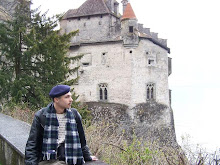
Now what can I saw about what is in fact the most impressive example of castlery in the country? Even as one approaches it, one’s step accelerates to match the beating of one’s heart. With the exception of the home of the Schweizerisches Landesmuseum (which is a castle/palace in its own right, yet whose interior lacks the sort of impregnable feel that the exterior would lead to believe) this is the first bona fide medieval fortification I’ve ever set foot inside. You can walk throughout most of the structure, from the courtyards to the towers (which give an amazing view of Lac Léman and the distant Alps), and a pamphlet explains the uses of all the various rooms (in English too!), which are many: prison, dining halls, bedrooms, even toilets (which naturally empty straight into the lake). In one semi-large hall, there was a collection of wooden chests from the 15th through 17th centuries. There were a few dozen (yes, I took pictures of them all), but for now I’ll just share one.

Hmm, I’m actually really at a loss for words here. Perhaps I’ll have more to say on it after I read the book I bought that explains the whole history of the castle. For now, I’ll just share some pictures:

A swan makes her nest at the base of the wall.
Extant wooden supports used in the creation of the vaulted ceiling.
A charcoal (!) sketch on a part of the plaster-covered wall in the prison area.
Coat of arms in stained glass.
A view of the castle, lake, and Alps.

Oh, I did forget to mention that the castle produces its own wine, Clos de Chillon. It’s available exclusively at the Château, and I did buy a bottle. OK fine, I bought two bottles. Hopefully at least one will back it back to the States. Here’s a glimpse of the vinyard, a stone’s throw away from the castle.

16 April 2008

Schweizerisches Landesmuseum

Possibly one of the nicest museums I’ve been to so far, the Landesmuseum has exhibits that span from prehistory, through Roman occupation (Helvetia), the middle ages, right up to the modern era. Unfortunately I was unable to take any pictures once inside the museum; there were many, many Medieval artefacts that I would’ve loved to have photos of, including some extant heraldic banners from the mid-15th through early 16th centuries made of painted canvas, silk, and silk damask (aquisition no.s KZ 5738, KZ 5732, ZB Zürich 850, and KZ 5636). There was also a complete set of clothing from around the same time period, including pourpoint (Wams, in German), trousers, woolen stockings, and a satin cap (acquisition no. LM 2396). Also, a doublet from the first half of the 17th century made of satin (aquisition no. LM 14005.2).

One of the best things at the museum, however, was the special exhibit “Medieval Book of Hours: From private devotion to luxury manuscripts”. There, I got to thumb through facsimile copies of both the Belles Heures.. and the Très Riches Heures du Duc de Berry! The most impressive book on display was actually also a facsimile: the so-called Livre d’Heures Noir, ca. 1475. This book has black pages – begotten by soaking the parchment in a ferrous-copper emulsion – and painted over in blue and gold. The original is held by the Pierpont Morgan Library in New York, NY. I must visit it.

I also learned a new term: das Besteck. Meaning “tucked away”, it refers to cutlery sets that no gentleman in the middle ages would be without.

One thing about the museum that disappointed me was the shop, or virtual lack thereof. It was about the size of a broom closet, and had only touristy things to buy. I had been hoping, due to my inability to take photographs, that I could at least purchase some postcards with some of the aformentioned pieces displayed, or perhaps some books on the collection. Perhaps it was due to the construction (the museum is currently being expanded), but perhaps not. O well, I suppose I’ll just have to go back another time.

Museum Bellerive

I visited this tiny little exhibit last Thurs. Basically, it’s a collection of architectural bits and pieces from the 19th century. I do mean bits and pieces quite literally; the main room on the ground floor is comprised of a few racks with mostly organized piles of things, from the locking mechanisms on doors, to the tiny little hinged figure-heads that prop the shutters open. (In Zürich, just about all the windows on all the buildings have shutters. And they are all held open by these little busts. Strangely enough, I haven’t taken a picture of any.) Here’s an image of the main room’s collections. Yes, it even includes quite a few kitchen sinks.

Other offshoot rooms featured elements such as wallpaper (extant pieces, sample books, even wood blocks for printing the patterns) or fancy wood inlay work. The picture at the head of this post is a detail from a panel that, beyond appearing three-dimensional due to the differently coloured pieces of wood, also included chunks of mirror to further confuse the eye. Made by Trix & Robert Haussmann, it’s called Türpaneel und Raumgitter (1980).

If you go, the exhibit may well be different: according to the cryptic blurb in my guidebook, the museum “displays its permanent collection in the form of a continuous programme of temporary exhibitions”. So essentially, they have a ton of stuff in storage and they rotate their way through it to make sure every piece of old house-bits gets its due time in the limelight. Or, at least time in another pile, but on a different set of shelves.

11 April 2008

Kunsthaus Zürich

Talk about lucky; the Kunsthaus is about a 2 minute walk from Natasha's flat. It's filled primarily with contemporary art, for example Torben Geihler's Matterhorn (2002), or Erwin Wurm's Guggenheim melting (2005). However, like the picture in this post indicates, there is some old art as well. To the left is the Kreuzigung of Giuliano di Simone (ca. 1400). Here's a detail. Here is a picture of Darbringung Christi by 'Der jüngere Berner Nelkenmeister'.

There was also a pair of portraits by Hans Asper there. Since I've now also been to the Landesmuseum, and seen a few more portraits of his, I've noticed that in multiple instances he's decorated women's belts with a clasped-hands motif. Unfortunately I couldn't take pictures in the Landesmuseum, but here's a detail of his Bildnis der Cleophea Krieg von Bellikon (1538). I want to keep an eye out for this motif now.